
Belonging and Mattering
Mattering?
Mattering is not new or different to belonging. It is a way of deepening our understanding and practice of belonging.
Mattering helps us look at belonging beyond the ‘brand’ or ‘mantras and manifestos’ leading to a “Enforced allegiance to some vague institutional mythology” (Luke Billingham)
Belonging - the feeling of being part of something.
‘I’m wanted here. I’m safe’
Mattering - the belief that you are significant to others.
We tell our children and young people, ‘you’re significant’, ‘your voice counts’, ‘your presence changes things’ - 'YOU MATTER!' (Dr Lisa Cherry)
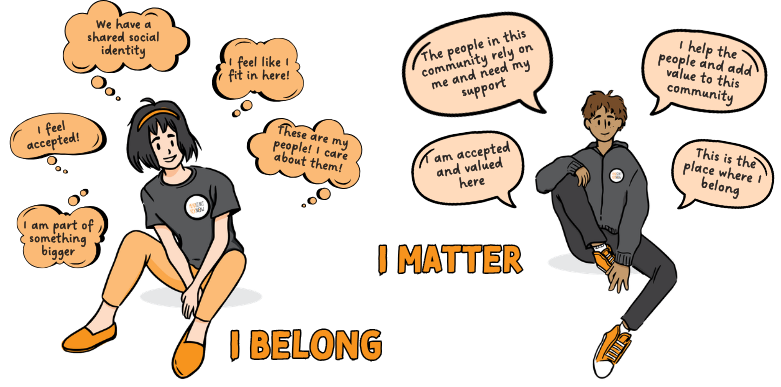
Mattering is important because it touches on several aspects of human experience. It shields us from loneliness by connecting us with others. Additionally, it boosts our self-esteem by affirming our value, and it strengthens our sense of belonging, anchoring us within our communities.
The Belonging Paradox (DfE Pupil Experience, 2025)
- 69% of pupils feel they "belong" (up from 57% in 2024), but learning motivation has dropped to 70%.
- Pupils feel institutional belonging but lack individual significance:
- Only 57% feel an adult "really cares."
- Only 61% feel "listened to."
- Demographic Disparities:
- SEND pupils, girls, and those on FSM report significantly lower belonging (60%avg.) than their peers (73%).
Mattering - key thinkers / researchers
Isaac Prilleltensky
Mattering depends on two things
- Feeling you are valued
- Feeling that you add value
"It is almost impossible for anything to matter to someone who doesn't first believe that they matter. Feeling valued is a precondition for personal health, but adding value is the prerequisite for a meaningful life."
Three factors that enable students to develop mattering
- Voice,
- Relationships,
- Participation
Belonging v Mattering
|
Belonging |
Mattering |
|
Fitting in |
Being significant |
|
Being included |
Being noticed and missed |
|
Being present |
Being valued and relied upon |
|
Often passive |
Active and relational |
(Prilleltensky & Prilleltensky, 2021)
Nancy Schlossberg
Mattering is the feeling of being noticed, needed, and important to others. She suggests that people need to feel they “count, belong, and matter” to avoid marginalisation.
The concept of marginalisation was introduced by Schlossberg in 1989
"The polar themes of marginality and mattering connect all of us - rich and poor, young and old, male and female. Are we part of things; do we belong; are we central
or marginal? Do we make a diference; do others care about us and make us feel like we matter?"
Marginalisation matters as we will find somewhere to belong whether it is healthy or unhealthy - gangs, becoming exploited, the 'manosphere', extremist ideologies...
"There are young men literally dying to be someone or something, anything but no-one and nothing".
(Lee Dema, Founder of St Matthew’s youth project, Brixton, London)
Rosenberg & McCullough
The Four Components of Mattering (1981)
Attention – Someone notices me.
Importance – I’m not invisible. I’m significant.
Dependence – Others rely on me. I contribute.
‘Missedness’ – If I disappeared, someone would care?
Gordon Flett
Mattering is ‘a huge life advantage when it is present but a huge burden when absent’
Introduced the concept of 'anti-mattering' - the abject feeling of being invisible, insignificant, or irrelevant to others. He argues this is not just the "low end" of mattering but a distinct, toxic psychological state that acts as a unique vulnerability factor for mental health issues.
Involved in the creation of 3 tools to measure Mattering / Antimattering
Flett has a particular interest in mattering in school. He believes that mattering in school matters more than mattering in general. ' Mattering and belonging are robust predictors of engagement, adjustment and academic success...' His work emphasises that a student's sense of significance is a primary driver of academic engagement, resilience, and long-term mental health.
Activities to promote matttering
- Peer Mentoring
- Student Ambassadors
- Opportunities for volunterring
How to support mattering**
- Spend time with people (any time is quality time)
- Be a great listener
- Let them have a voice
- Acknowledge when they have been missed
- Remember things important to them (interests, events etc.)
**very reminiscent of Professor Tim Brighouse's '20 things...'
Thinking about mattering
Consider pupils in your school. Ask:
- If X stopped coming to school would they feel that their absence has been noted.
- Does every child have positive and affirming relationships with their peers and with at least one trusted adult.
- Are students actively shaping the school environment or simply complying with expectations.


Thinking about mattering
- How can we embed the message in our school culture that every child's presence matters?
- What daily opportunities can we create for pupils to feel relied upon and contribute?
- If motivation links to personal significance, how must we change our strategy for disengaged pupils?
- What single, school-wide 'micro-interaction' policy can we champion to ensure every 'hidden' pupil feels noticed, important, or needed?
Further reading
Mohamed Abdallah (The Reach Foundation)
Mohamed Abdallah gave a keynote speech at the CAPH Transforming Inclusion Conference in March 2026.
His substack, The Drawbridge Collective contains further articles.
Dr Lisa Cherry
blog articles including:
Belonging and Mattering as Protective Buffers
The Rise and Rise of Mattering in Education
Dr Cherry has recently shared a Belonging and Mattering Audit Tool - A practitioner tool for schools, colleges, universities and social care teams.